Overview
Syllabus overview
Organisation of Classical Languages K–10
The diagram (Figure 1) is an overview of the Classical Languages K–10 Syllabus. It shows that:
- understanding texts is necessary to access classical languages and cultures. Students apply knowledge of language systems to understand texts
- translation is a core skill in the study of a classical language. By translating texts, the analysis of language reinforces meaning
- intercultural understanding involves learning about the classical world, making connections and comparisons, and reflecting on language, culture and identity.
Across a stage of learning all focus areas need to be taught.

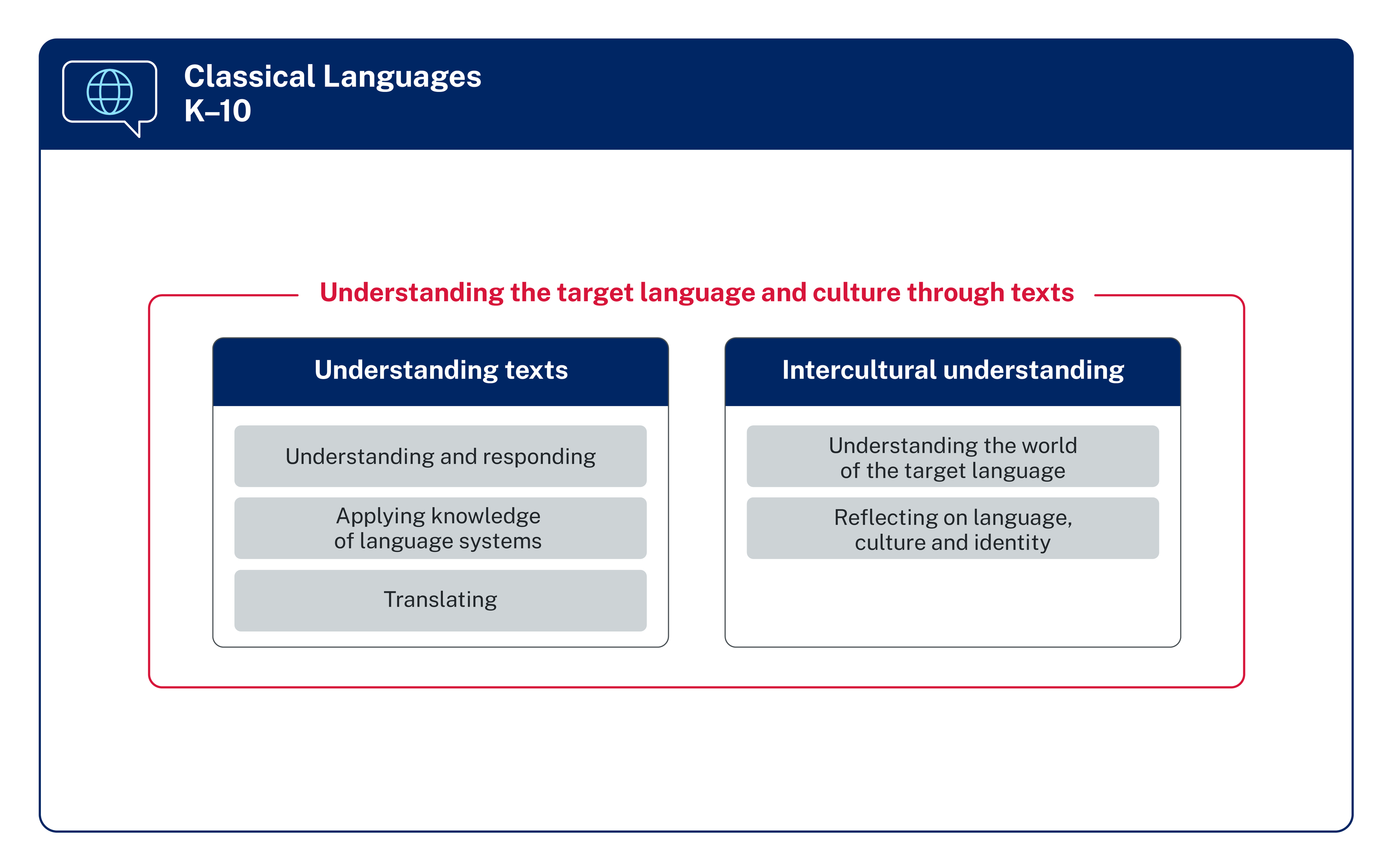
Image long description: The diagram shows 'Understanding the target language and culture through texts' encompassing 2 of the focus areas of Understanding texts and Intercultural understanding. Below the first focus area is 'Understanding and responding', 'Applying knowledge of language systems' and 'Translating'. Below the second focus area is 'Understanding the world of the target language' and 'Reflecting on language, culture and identity'.
Access content points
Access content points have been developed to support students with significant intellectual disability who are working towards Early Stage 1 outcomes. These students may communicate using verbal and/or nonverbal forms.
For each of the Early Stage 1 outcomes, access content points are provided to indicate content that students with significant intellectual disability may access as they work towards the outcomes. Teachers will use the access content points on their own, or in combination with the content for each outcome.
Decisions regarding curriculum options for students with disability should be made in the context of collaborative curriculum planning.
Life Skills outcomes and content
Students with disability can access the syllabus outcomes and content in a range of ways. Decisions regarding curriculum options should be made in the context of collaborative curriculum planning.
Some students with intellectual disability may find the Years 7–10 Life Skills outcomes and content the most appropriate option to follow in Stage 4 and/or Stage 5. Before determining whether a student is eligible to undertake a course based on Life Skills outcomes and content, consideration should be given to other ways of assisting the student to engage with the Stage 4 and/or Stage 5 outcomes, or prior stage outcomes if appropriate. This assistance may include a range of adjustments to teaching, learning and assessment activities.
Life Skills outcomes cannot be taught in combination with other outcomes from the same subject. Teachers select specific Life Skills outcomes to teach based on the needs, strengths, goals, interests and prior learning of each student. Students are required to demonstrate achievement of one or more Life Skills outcomes.
Protocols for collaborating with Aboriginal and Torres Strait Islander Communities
NESA is committed to working in partnership with Aboriginal Communities and supporting teachers, schools and schooling sectors to improve educational outcomes for young people.
It is important to respect appropriate ways of interacting with Aboriginal Communities and Cultural material when teachers plan, program and implement learning experiences that focus on Aboriginal and Torres Strait Islander Priorities.
Indigenous Cultural and Intellectual Property (ICIP) protocols need to be followed. Aboriginal and Torres Strait Islander Peoples’ ICIP protocols include Cultural Knowledges, Cultural Expression and Cultural Property and documentation of Aboriginal and Torres Strait Islander Peoples’ identities and lived experiences. It is important to recognise the diversity and complexity of different Cultural groups in NSW, as protocols may differ between local Aboriginal Communities.
Teachers should work in partnership with Elders, parents, Community members, Cultural Knowledge Holders, or a local, regional or state Aboriginal Education Consultative Group. It is important to respect Elders and the roles of men and women. Local Aboriginal Peoples should be invited to share their Cultural Knowledges with students and staff when engaging with Aboriginal histories and Cultural Practices.
Creating written texts supports learning
The development of the Classical Languages Syllabus follows Recommendation 2: ‘Clarify and strengthen writing content in syllabus documents’ from Teaching Writing: Report of the Thematic Review of Writing (NESA 2018).
Creating written texts facilitates learning as it promotes explicitness, encourages the integration of ideas, supports reflection, fosters personal engagement and aids learners to think about the significance and implication of ideas. Each subject has particular and specific writing demands relevant for communicating within and about the discipline. Writing about content enhances understanding across subjects and stages.
The secondary curriculum includes:
- systematic development of expectations for creating written texts which align with the English K–10 Syllabus (2022)
- explicit writing content to support students to become fluent creators of texts and to deepen their understanding of the subject area
- opportunities to practise the process of creating written texts to develop and communicate knowledge, understanding and ideas
- a focus on development of word consciousness and precise use of subject-specific terminology.
Creating written texts refers to the act of composing and constructing a text for a particular purpose, audience and context.
Various methods of transcription may be employed, and a student’s preferred communication form(s) should be considered when teaching.
Balance of content
The amount of content associated with a given outcome is not necessarily indicative of the amount of time spent engaging with the respective outcome. Teachers use formative and summative assessment to determine instructional priorities and the time needed for students to demonstrate expected outcomes.
In considering the intended learning, teachers make decisions about the sequence and emphasis to be given to particular groups of content based on the needs and abilities of their students.
Syllabus framework
The Classical Languages K–10 Syllabus is a framework that can be used to teach a classical language in New South Wales. A classical language is any language with an independent literary tradition and a large and ancient body of written literature. Classical Languages are no longer spoken as a first language.