Syllabus development in NSW
Syllabus development process
Development of K–12 syllabuses
As part of the NSW Curriculum Reform, NESA has streamlined and refined the syllabus development process. Syllabuses describe the essential learning required in each subject, identify the knowledge and skills to be learnt, and provide opportunities for students to apply skills in each subject.
The new syllabus development process is based on evidence and allows for:
- Quality assurance. Consistency of approaches to all syllabuses.
- Accessibility. Information available and accessible for everybody.
- The Australian Curriculum. Adopt and adapt where relevant.
- Transparency. Clear governance structures, and public trust in the syllabus development process.
- Research and evidence. Practising teachers and academic experts provide start-to-finish syllabus development advice.
- Currency. The new process ensures syllabuses remain contemporary.
Syllabus prioritisation
To prioritise NESA’s program of work, we have 3 categories of syllabus development. Syllabuses are categorised as one of the following:
- major redevelopments
- moderate revisions
- minor changes.
The underlying processes and procedures for syllabus development vary in complexity based on the syllabus categorisation.
Stakeholders
We engage with a range of stakeholders throughout the syllabus development process. The role of each stakeholder varies, but each plays a part in ensuring a high-quality, fit-for-purpose syllabus.
Stakeholder engagement
Syllabus development typically involves engagement with a wide variety of stakeholders, including:
- teachers
- subject experts
- school sectors
- professional associations
- Aboriginal and Torres Strait Islander people
- diverse learning groups (including disability, EAL/D, and gifted education)
- unions
- students
- parent groups
- community groups.
The following stakeholders are directly involved in quality assuring, endorsing and approving finalised syllabuses.
- Technical Advisory Group (TAG): The TAG is an advisory group that provides expert advice and quality assurance of the outcomes and content of a draft syllabus. TAG members are selected based on their expertise. They may include academics or practising teachers with deep knowledge of their subject area, curriculum development and student learning.
- Curriculum and Credentials Committee (CaCC): The CaCC is the NESA committee responsible for final endorsement of syllabuses. The CaCC also endorses syllabuses developed by schools and other education providers. To ensure a coherent relationship between Stage 6 syllabuses and award of the Record of School Achievement (RoSA) and the Higher School Certificate (HSC), the CaCC also approves rules, requirements and examination specifications for the HSC.
- Minister for Education and Early Learning: Approves the final syllabuses for publication and implementation in NSW schools.
Phases of the syllabus development process
The K–12 syllabus development process is divided into 4 phases:
- Writing
- Consultation
- Approval
- Preparation and implementation.

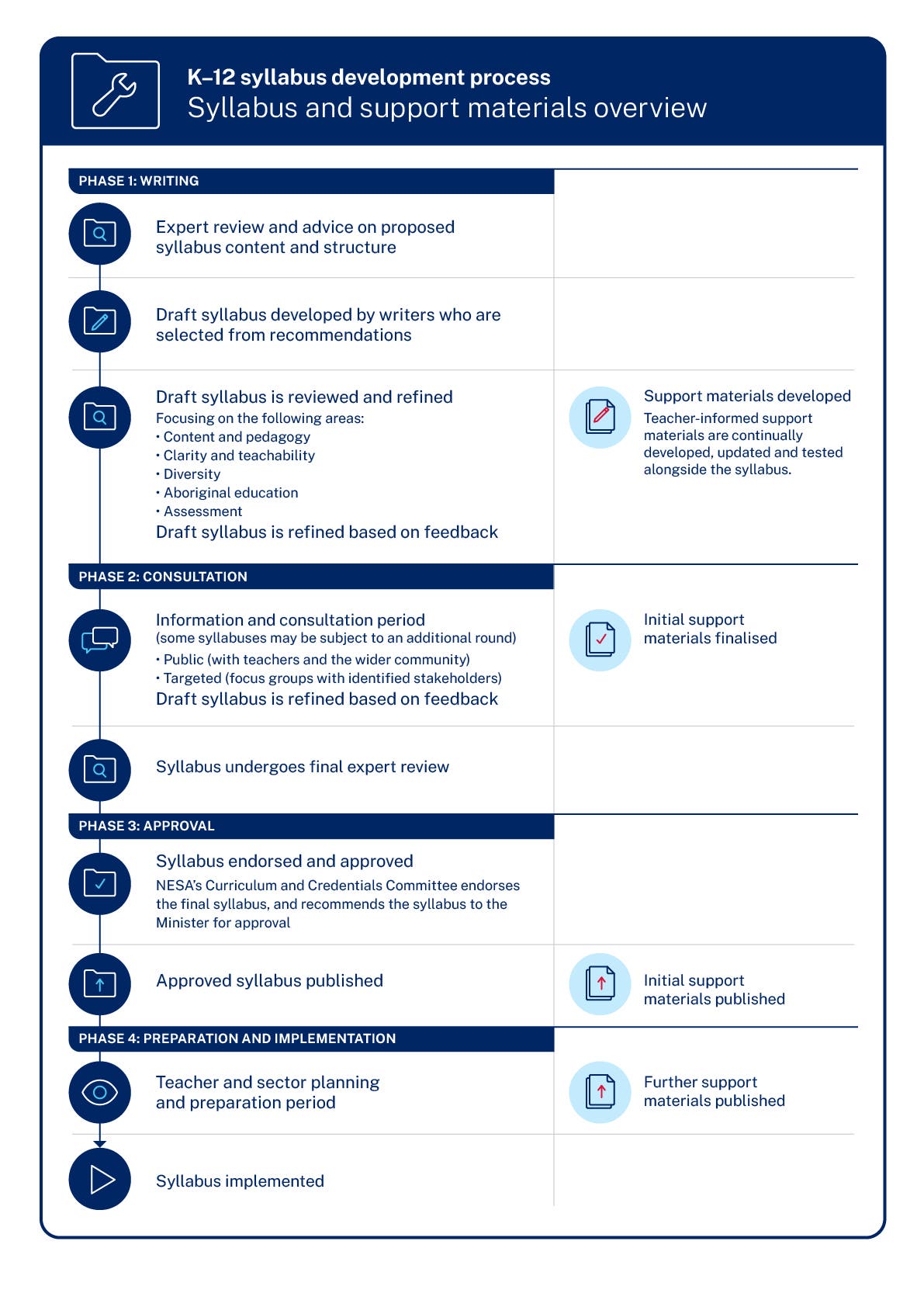
Phase 1: Writing
At the end of this phase, draft syllabus documents are ready for public consultation.
Expert review
Guided by the NSW curriculum reforms, NESA conducts a review of the existing syllabus and performance standards to identify strengths and areas for improvement. This review also considers:
- relevant government recommendations and priorities
- previous syllabus reviews and evaluations
- content and sequencing
- research, evidence and academic advice
- assessment expertise and insights into K–12 assessment practices
- alignment with the Australian Curriculum (where relevant).
Every NESA syllabus is quality assured by a TAG. The TAG is made up of subject experts who:
- provide feedback on the review of the existing syllabus
- affirm the directions for new syllabus development
- provide expert advice throughout the iterative development of the syllabus.
NESA consults the TAG throughout the project to ensure syllabuses reflect evidence-based research and best practice.
Writing the draft syllabus
Select writers
NESA seeks recommendations from key stakeholders, including school sectors, unions and teacher professional associations, to form a pool of syllabus and support material writers. NESA uses a panel selection process to select writers from this pool based on merit. The number of writers appointed depends on the extent of redevelopment required.
A syllabus writing team includes a mix of teachers and subject experts. This team will have expertise in:
- the subject, including experience in teaching the subject
- Aboriginal Education (Aboriginal person with school-based experience as a teacher or academic)
- diverse learning (including disability, EAL/D, and gifted education)
- English as an Additional Language or Dialect (for English syllabuses)
- Life Skills (for applicable Life Skills syllabuses).
Draft syllabus
Writers are guided by findings of the review to develop the first draft of the syllabus overseen by NESA subject matter experts.
Review draft syllabus
To ensure a diverse range of perspectives on the early drafts of these syllabuses, a range of concurrent targeted reviews are conducted by:
- Content and pedagogy experts (including TAG) focusing on content, including clarity and teachability, and sequencing
- Diverse learning experts focusing on accessibility, inclusivity and diverse representations
- Aboriginal Education stakeholders focusing on appropriateness and cultural safety
- Assessment experts focusing on the assessability of outcomes and content
- Practising teachers (where relevant) focusing on clarity and teachability.
NESA refines the draft syllabus based on the feedback from the targeted review and releases this version of the draft syllabus for consultation.
Phase 2: Consultation
In this phase, draft syllabus documents are made available to the public.
Different styles of engagement, both in person and virtual, are used to gather feedback from the diverse range of stakeholders in NSW. Where relevant, NESA is increasing online methods of consultation to ensure collected feedback reflects the metropolitan, regional and remote NSW population.
Public information and Have your say period
NSW syllabuses have strong community ownership due to public consultation and stakeholder engagement. The public information and Have your say period enables NESA to provide timely opportunities for all stakeholders to receive information about and provide feedback on the development of syllabuses.
The number and duration of Have your say periods varies based on the scope of syllabus redevelopment required.
Targeted feedback sessions with stakeholders
NESA conducts targeted consultation with key education stakeholder groups to collect feedback on draft syllabus documents.
The following groups are consulted for syllabus projects:
- Aboriginal and Torres Strait Islander people
- Roundtable of principals’ associations, unions, and professional associations
- Diverse learning groups
- School sectors, students and teacher expert networks (TENs), where relevant
- Subject-specific professional associations.
Other targeted feedback sessions are held with education stakeholders based on the level of syllabus redevelopment required, and where relevant.
Engagement report
Once all feedback has been collated and analysed, NESA produces an Engagement report outlining the overall themes.
Final draft syllabus and expert review
Writers refine the draft syllabus documents based on the feedback gathered during public Have your say periods and targeted consultation sessions. A final expert review by the TAG provides quality assurance before the approval phase.
Phase 3: Approval
At the end of this phase, teachers can access the approved syllabus and support materials and begin preparation for teaching.
NESA has a rigorous syllabus endorsement and approval process to quality assure the final syllabus package.
Syllabus endorsement
The NESA CaCC endorses the final syllabus. This endorsement acts as a recommendation to the Minister for Education and Early Learning to approve the final syllabus.
Ministerial approval
The Minister for Education and Early Learning approves the new syllabus for publication and implementation in NSW schools.
Syllabus publication
NESA publishes online the approved syllabus and package of support materials.
Phase 4: Preparation and implementation
In this phase, the new syllabus is available for teachers to start implementing in their schools. Teachers engage in professional learning.
Preparation and planning
NESA works with school sectors, teachers and professional associations to support implementation of the new syllabus. Development of support materials may continue during this period, depending on the level of redevelopment and change made to the new syllabus.
Implementation
Schools start implementing the new syllabus.
Support materials
Essential support materials are developed alongside the syllabus and are typically published as part of the syllabus package. Further support materials may be developed and released after the publication of the syllabus, based on the need and complexity of change in the new syllabus.
Related information
- Loading
- Loading
- Loading