Curriculum framework
Curriculum framework for new syllabuses
NESA has developed a new curriculum framework to ensure consistency and coherence across syllabuses.
NSW syllabuses are inclusive of all students, in accordance with Loading .
NSW Curriculum syllabuses balance new features with valued elements from the pre-reform structure, and include:
- an overview of the syllabus
- a rationale detailing the value and importance of the subject for student learning
- an aim that encompasses syllabus objectives
- outcomes and content
- Loading (previously identified as ‘Learning across the curriculum’)
- specific requirements for delivery
- mapping to Loading content.
The NSW Curriculum makes the essential elements of the syllabus clear: the Overview, Rationale, Aim, Outcomes and Content. This framework means less time and effort are required to interpret and unpack a syllabus. Non-mandatory materials are also provided to support teachers, allowing them to make their own professional judgment about whether they use these materials or not. These optional materials include embedded links to examples and teaching advice, support materials, and resources.
Focus on essential content
New syllabuses focus on essential content, which identifies the core skills and knowledge necessary for developing teaching and learning programs.
Essential content:
- stands alone without the need for further elaboration, and can be easily sequenced
- is necessary for students to progress in their learning
- is part of students’ learning entitlement – the knowledge and skills that every student should have an opportunity to learn.
‘Essential content’ does not define limits to student learning, but sets out what every student has a right to know. Schools and teachers will make decisions about increasing depth or breadth of content based on the needs of their students and their local context.
To assist schools and teachers, support materials including examples and teaching advice are provided.
Explicit knowledge and skills
The NSW Curriculum articulates what students are expected to know, understand and be able to do. It is explicit about the knowledge and skills to be learnt.
Knowledge underpins our ability to think and do. Students learn new ideas with reference to their existing knowledge. In each learning area, background knowledge, committed to long-term memory, is vital to literacy development and underpins the ability to think critically and creatively. There are bodies of subject-specific knowledge that students must have an opportunity to learn and remember.
Each subject also includes specific skills, tools, methods, processes and strategies that students develop as they achieve an outcome.
The following NESA principles promote the creation of a curriculum that is explicit about knowledge and skills:
- knowledge content in syllabuses must be explicitly stated and not merely implied as part of skills, processes or learning experiences
- explicit subject knowledge is identified as the intended learning to achieve the syllabus outcomes
- explicit subject knowledge is identified and sequenced to support progression in the syllabus
- explicit knowledge across all learning areas is identified and sequenced to support vocabulary development for reading and writing
- explicit subject knowledge is identified and sequenced to support student learning which underpins the development of critical and creative thinking.
The curriculum also plays a key role in identifying the shared knowledge that fosters belonging and cross-cultural understanding in our society.
Explicit inclusion of writing in syllabuses
The Thematic Review of Writing, the NSW Curriculum Review and other research recommend a more explicit focus on writing in the curriculum, including the need to:
- clarify and strengthen ‘writing’ content in all syllabus documents
- provide coherent direction for teaching writing in all subjects.
Students will learn skills to express their ideas clearly by writing, and write texts for different contexts, purposes and audiences. A specific focus on writing also gives students more opportunities to practise.
Writing facilitates learning because it promotes clarity, encourages integration of ideas, supports reflection, and fosters engagement with information. Writing helps learners think about the significance and implication of ideas.
All new syllabuses provide advice on the teaching of writing, creating a common, consistent language for the teaching of writing in primary and secondary schooling, and across all learning areas.
Principles for new K–12 syllabuses
The reform priority of building strong foundations for future learning began with new English and Mathematics syllabuses for Kindergarten to Year 2 from 2023.
The new K–12 syllabuses are informed by principles that reflect the enduring values of the NSW education community, together with the reform directions identified in the NSW Government Response to the 2020 NSW Curriculum Review.
The principles explained in detail below are the bedrock of the new K–12 syllabuses. They help support excellence, equity and academic achievement in NSW schools, from early fundamentals to increasing degrees of competence in later years.
1. Context
NSW syllabuses are structured according to the legislative requirements of the NSW Education Act 1990 and are developed in alignment with the goals of the Alice Springs (Mparntwe) Education Declaration 2019. These goals include a commitment to ensuring that ‘the Australian education system promotes excellence and equity’, and that ‘all young Australians become confident and creative individuals, successful lifelong learners, and active and informed members of the community’.
NESA’s Statement of Equity Principles is central in forming the curriculum’s purpose and values. The statement positions inclusion and accessibility as key educational values, acknowledging that NSW students come from diverse cultural, linguistic, social, economic, geographic and family backgrounds. This includes:
- Aboriginal and Torres Strait Islander students
- students with disability
- students with language backgrounds other than English, including those who are learning English as an additional language or dialect
- gifted and talented students
- students from communities with low socioeconomic status
- students from rural and remote areas
- refugees
- those at risk of disengaging from school
- students who can be disadvantaged by various forms of gender stereotyping.
2. Fundamental features and foundations
The central place of subjects and syllabuses
The NSW curriculum remains committed to a general education grounded in subjects, which are organised through key learning areas and based in recognised academic disciplines. This helps structure a student’s educational journey through the development of discipline-specific knowledge.
NESA-developed syllabuses continue to be the key instrument used by schools to develop classroom-level teaching programs and whole-school curriculum planning. Syllabuses provide a sequence of learning that builds on prior learning and lays the foundations for further learning of knowledge, understanding and skill.
Syllabus elements
NSW syllabuses developed for the reform include common elements and retain familiar terminology.
The structure for NSW syllabuses focuses on elements that:
- make the intentions of the syllabus clear
- enable meaningful teaching, learning and assessment for every student, in line with NESA requirements
- allow flexibility to meet student needs and interests.
As such, the new syllabuses include:
- an overview indicating the organisation of the subject area and important requirements for student learning
- a rationale that provides a common understanding about the value and importance of the subject for student learning
- an aim which outlines the overall purpose of the syllabus in relation to the subject which is inclusive of objectives
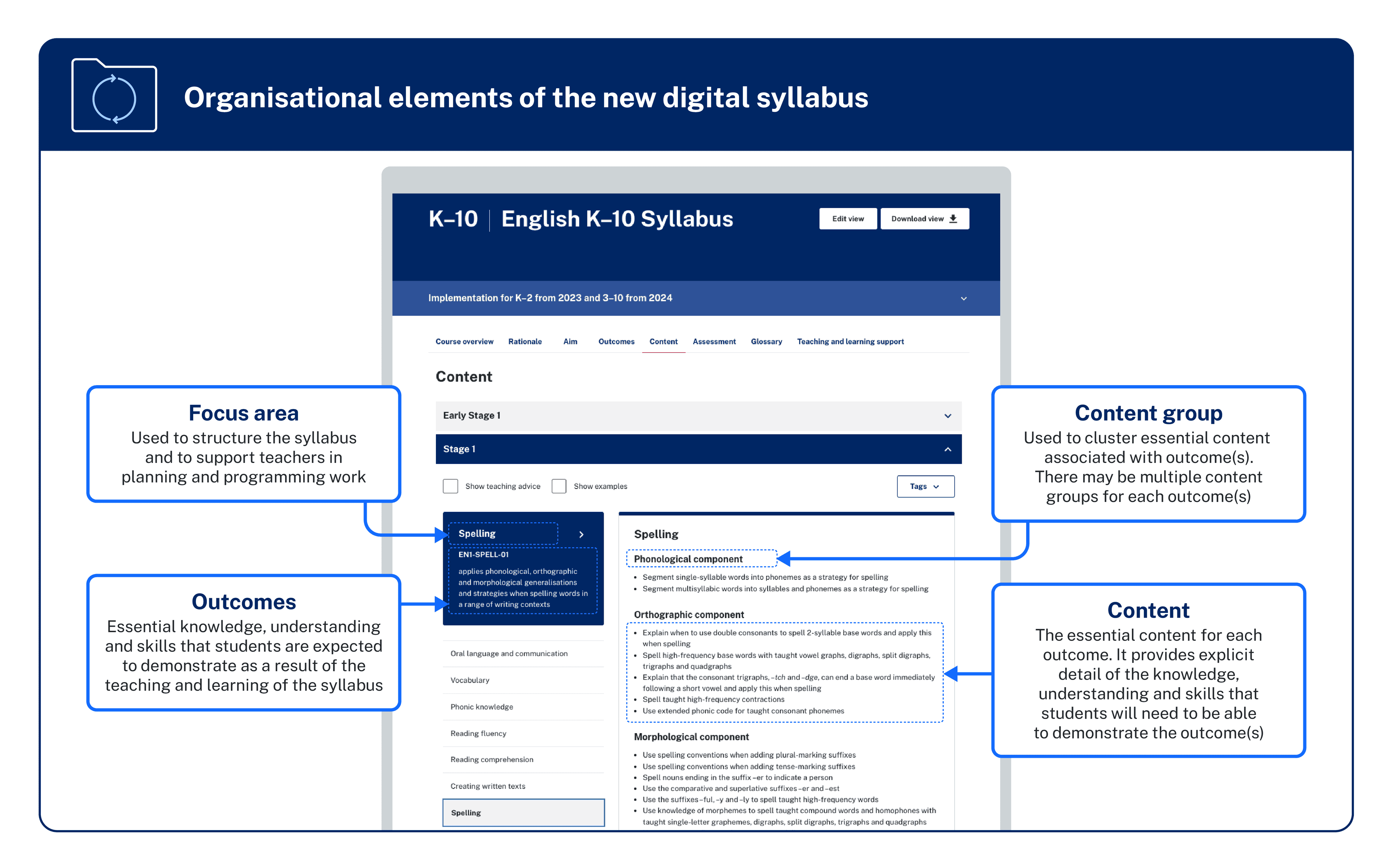
- outcomes that are concise statements of the essential knowledge, understanding and skills that students are expected to demonstrate as a result of the teaching and learning of the syllabus. They represent a progression of learning and provide a basis for students to move forward to the next stage of learning.
- content describes the essential content for each outcome. It provides explicit detail of the knowledge, understanding and skills that students will need to be able to demonstrate the outcome(s).

The role of standards in the K–12 curriculum
Student progress is monitored according to educational standards that clearly and explicitly describe the expected learning outcomes for all students. These outcomes, as well as syllabus content, work samples and performance descriptions (in Stages 5 and 6), contribute to an understanding of expected standards.
Assessment of student achievement is measured against these standards. It provides the information necessary for teachers and schools to improve teaching and learning, and to set targets for improvement. Assessing performance against these standards allows teachers to provide meaningful feedback to students about their current level of achievement, and to inform targeted teaching for appropriate next steps in student learning.
3. Key principles of the new curriculum
The 3 key principles that underpin all new syllabuses are informed by the recommendations of the 2020 NSW Curriculum Review. These recommendations stress that students should build strong foundations at every stage of school; learn with understanding; develop skills in applying knowledge; and make excellent ongoing progress.
The principles, detailed below, have been a focus in the development of the new K–12 syllabuses.
Principle 1: Building strong foundations
The principle of strong foundations informs the new curriculum structure. Students are provided with the learning opportunities they need to succeed and progress through each phase of learning. This focus on an appropriately sequenced continuum of learning is essential to enable students to make excellent ongoing progress.
Building strong foundations starts with new English and Mathematics K–2 syllabuses. These syllabuses provide the essential skills necessary for future learning at this critically important time for student development. They have been designed and developed based on a strong evidence base and with broad engagement with the educational community.
This includes making outcomes more explicit and specifically identifying essential learning. Outcomes are organised in the new syllabuses to help teachers identify key student knowledge, understanding and skills.
The evidence shows that the best way to improve student outcomes is by focusing on essential learning, including its sequencing, to build foundational skills in English and Mathematics. The explicit focus on these skills in the curriculum signifies their importance in the early years.
Strong foundations in literacy and numeracy unlock a child’s academic potential as they deepen their learning. New syllabuses will establish the foundations required to build disciplinary knowledge through clearly described and understood outcomes. Through the middle and senior years, students develop increasingly specialised knowledge and skills that will support them in future study, careers and life.
Principle 2: A focus on core content
The depth of the foundations that students establish at school depends on how well prepared they are to embark on each new phase of learning. In the early years, this is accomplished through a more explicit focus on foundational knowledge. In the later years, the amount of content teachers are expected to cover in some learning areas will be reduced, with content building across the school years to support deep understanding in each subject. Syllabuses explicitly focus on the core knowledge, skills and understanding essential for students’ learning to grow in that subject.
This principle is at the heart of the reform: students learn with understanding to acquire the capabilities, knowledge and skills necessary to grow in their learning. Students need to understand the content, concepts and principles related to their study of a subject, so that their knowledge and skills in that subject can develop over time.
New syllabuses recognise that education must focus on both theory and practice and provide opportunities for students to apply conceptual learning in a meaningful way. These syllabuses:
- include skills that require the application of knowledge, such as communication, collaboration, and critical and creative thinking skills
- recognise that an integral part of learning in a subject is the subject-specific ways in which capabilities are understood, developed and demonstrated.
Principle 3: Flexibility to meet individual student needs and abilities
School communities and teachers require flexibility to develop programs, structures and pedagogical practices that meet, support and extend the educational needs of their students. This principle understands that teachers, schools and school authorities are best placed to decide how to maximise student learning within their local context. It also understands that the effective assessment of student achievement will best guide decisions on how learning can be improved for each student.
The new syllabuses have been designed to help teachers translate these educational principles into effective and purposeful action in the classroom.
Related information
- Loading