Overview
Syllabus overview
Organisation of Mathematics K–10
The syllabus structure illustrates the important role Working mathematically plays across all areas of mathematics and reflects the strengthened connections between concepts. Working mathematically has been embedded in the outcomes, content and examples of the syllabus.
Mathematics K–10 outcomes and their related content are organised in:
- Number and algebra
- Measurement and space
- Statistics and probability
Working mathematically
The Working mathematically processes present in the Mathematics K–10 syllabus are:
- communicating
- understanding and fluency
- reasoning
- problem solving.
Students learn to work mathematically by using these processes in an interconnected way. The coordinated development of these processes results in students becoming mathematically proficient.
When students are Working mathematically it is important to help them to reflect on how they have used their thinking to solve problems. This assists students to develop ‘mathematical habits of mind’ (Cuoco et al. 2010).
Students need many experiences that require them to relate their knowledge to the vocabulary and conceptual frameworks of mathematics.
Overarching Working mathematically outcome
To highlight how these processes are interrelated, in Mathematics K–10 there is one overarching Working mathematically outcome.
A student develops understanding and fluency in mathematics through:
- exploring and connecting mathematical concepts
- choosing and applying mathematical techniques to solve problems
- communicating their thinking and reasoning coherently and clearly.
The Working mathematically outcome describes the thinking and doing of mathematics. In doing so, the outcome indicates the breadth of mathematical actions that teachers need to emphasise. The overarching Working mathematically outcome is the same across the K–10 Mathematics syllabus.
The Working mathematically processes should be embedded within the concepts being taught. Embedding Working mathematically ensures students are able to fluently understand concepts and make connections to other focus areas. The mathematics focus area outcomes and content provide the knowledge and skills for students to reason about, and contexts for problem solving. The overarching Working mathematically outcome is assessed in conjunction with the mathematics content outcomes. The sophistication of Working mathematically processes develops through each stage of learning and can be observed in relation to the increase in complexity of the mathematics outcomes and content. A student's level of competence in Working mathematically can be monitored over time, for example, within Additive Relations by the choice of strategy appropriate to the task, and the use of efficient strategy for the stage of learning the student is working at.
Further information is available in Loading (Word, 5 pages, 914.28 KB).

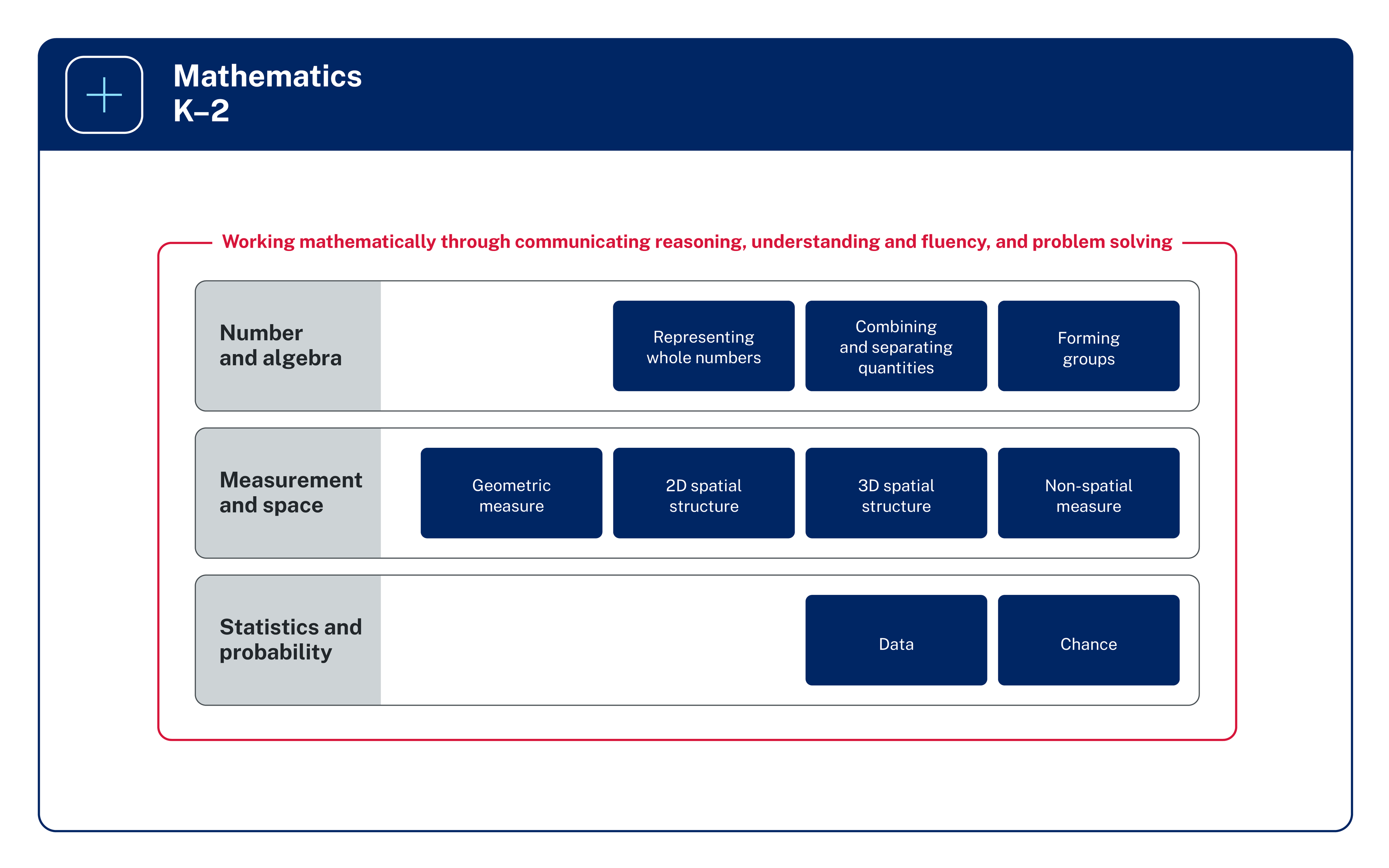
Image long description: An overview of the syllabus structure for Early Stage 1 and Stage 1 in Mathematics across the 3 areas of Number and algebra, Measurement and space, and Statistics and probability. Number and algebra reads horizontally across Representing whole numbers, Combining and separating quantities, and Forming groups. Measurement and space reads horizontally across Geometric measure, 2D spatial structure, 3D spatial structure, and Non-spatial measure. Statistics and probability reads horizontally across Data and Chance.

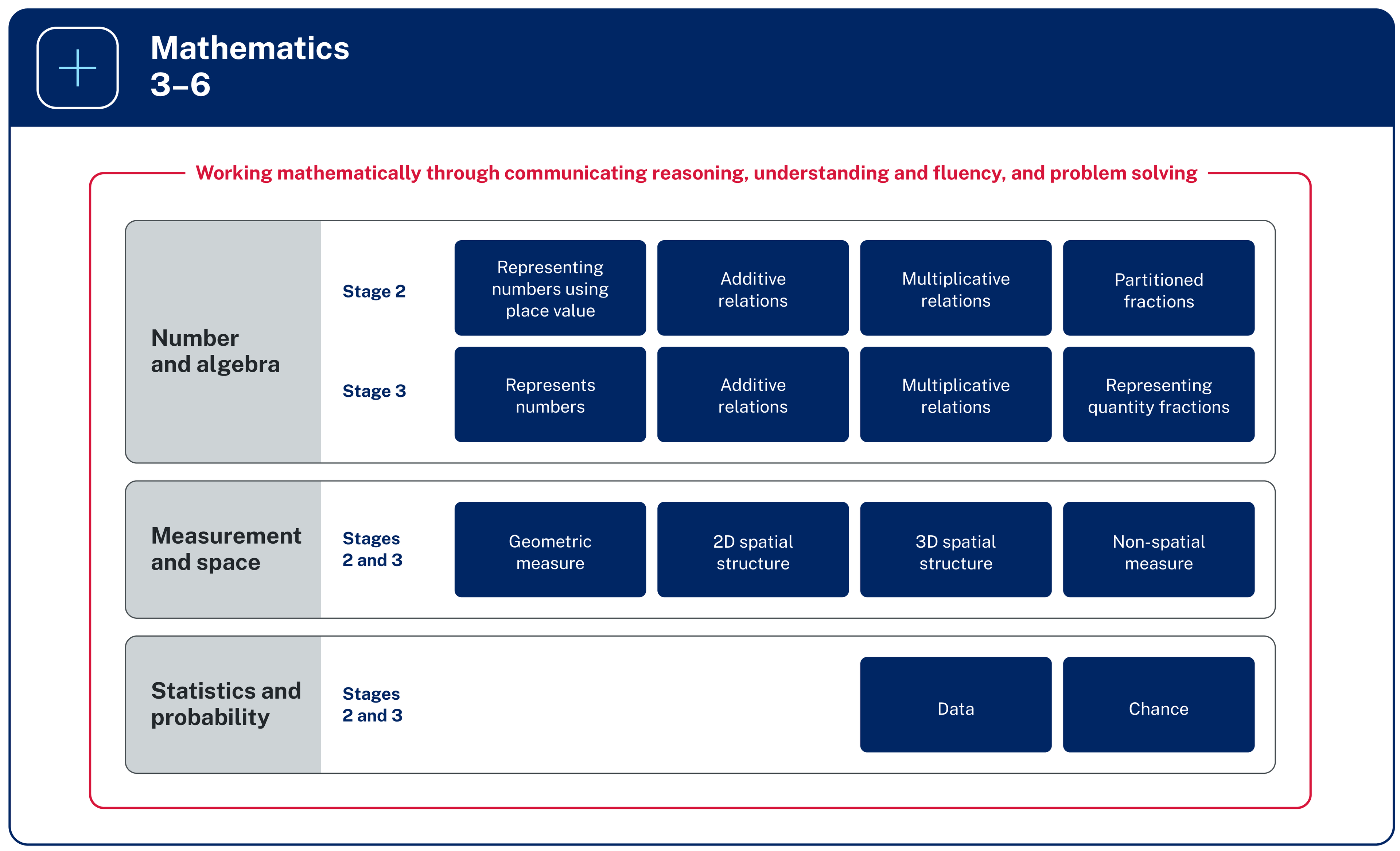
Image long description: An overview of the syllabus structure for Stages 2 and 3 in Mathematics across the 3 areas of Number and algebra, Measurement and space, and Statistics and probability. Number and algebra reads horizontally across 2 stages – Stage 2 and Stage 3. Stage 2 learning areas include Representing numbers using place value, Additive relations, Multiplicative relations and Partitioned fractions. Stage 3 learning areas include Represents numbers, Additive relations, Multiplicative relations, and Representing quality fractions. Measurement and space reads horizontally across 2 stages – Stages 2 and 3. Learning areas include Geometric measure, 2D spatial structure, 3D spatial structure, and Non-spatial measure. Statistics and probability reads horizontally across 2 stages – Stages 2 and 3. Learning areas include Data and Chance.
K–6 Parts A and B
Across a stage of learning all focus areas need to be taught. Mathematics focus areas outline the development of several concepts. In Mathematics K–6, where stages span 2 years of learning (for example, Stage 2 includes Year 3 and Year 4), there are concepts that may need to be addressed earlier or later in the stage.
To assist programming, the content in these focus areas has been separated into 2 parts, A and B, such as in Representing Numbers Using Place Value – A and Representing Numbers Using Place Value – B:
- Part A typically focuses on early concept development
- Part B builds on these early concepts.
The content across Parts A and B relates to the same stage-based outcomes. Teachers can choose which content from Part A and/or Part B to address, based on students’ prior learning, needs and abilities.
For example, in Stage 2, Part A does not equate to Year 3 only. When teaching a Year 4 class, the teacher may need to address or consolidate some concepts within Part A prior to addressing concepts in Part B. Similarly, when teaching a Year 3 class, the teacher may decide to address concepts in Part B based on the students’ prior learning, needs and abilities.
The Part A and Part B structure of the content:
- provides flexibility for teachers in planning teaching and learning programs based on the needs and abilities of students
- helps to better visualise the progression and growth of concepts within a stage of learning
- makes clear how content builds to support deep understanding in each focus area.
Considerations for planning teaching and learning programs include:
- when students may have learnt some concepts from Part B content in the first year of a stage, consolidation of these concepts in the second year of a stage may be needed
- revisiting concepts regularly to build deeper understanding of mathematical concepts
- providing extension of certain concepts based on students’ needs and abilities.
Access content points K–6
Access content points have been developed to support students with significant intellectual disability who are working towards Early Stage 1 outcomes. These students may communicate using verbal and/or nonverbal forms.
For each of the Early Stage 1 outcomes, access content points are provided to indicate content that students with significant intellectual disability may access as they work towards the outcomes. Teachers will use the access content points on their own, or in combination with the content for each outcome.
Decisions regarding curriculum options for students with disability should be made in the context of collaborative curriculum planning.

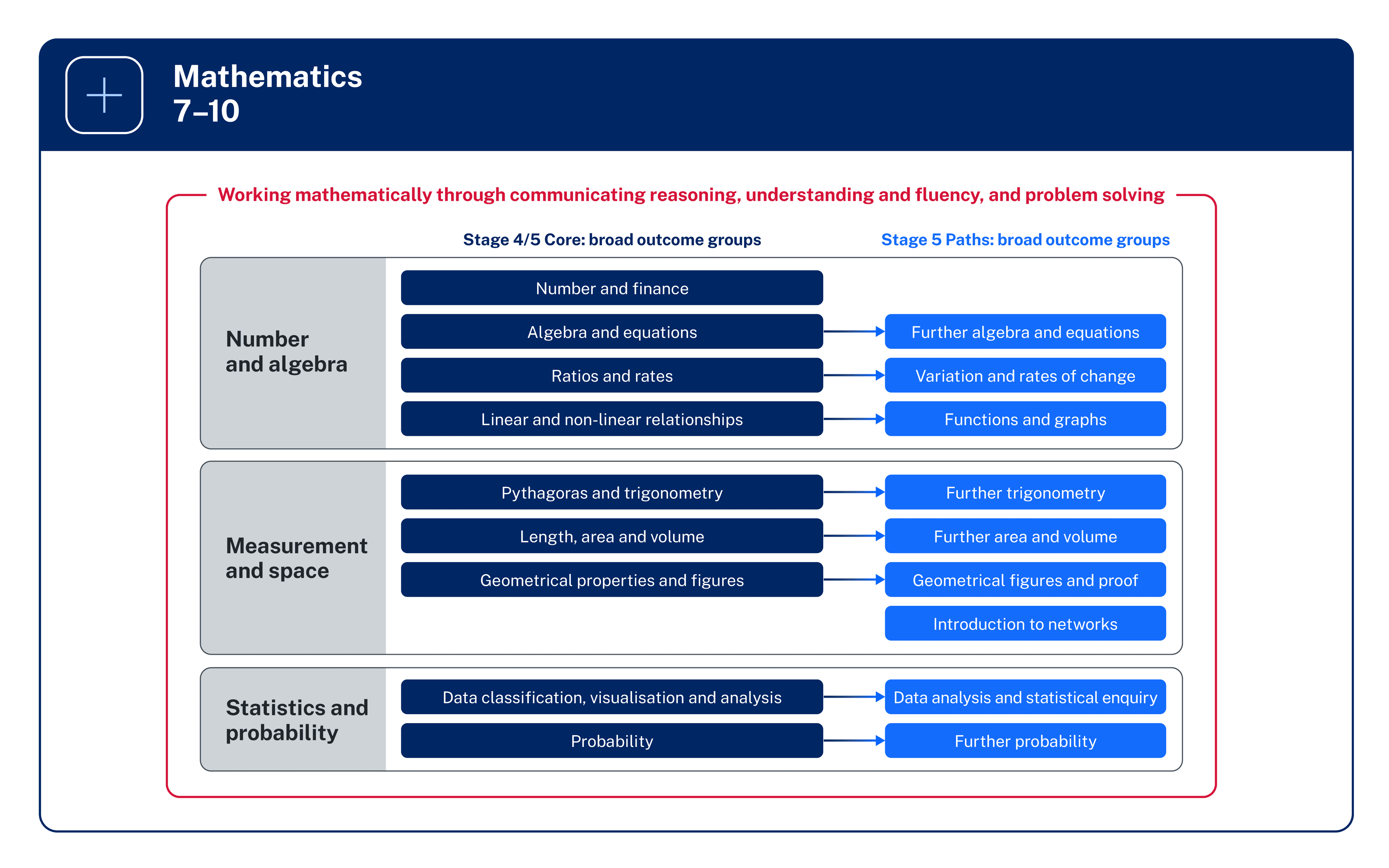
Image long description: Stage 4/5 Core: broad outcome groups are Number and finance, Algebra and equations, Ratios and rates, Linear and non-linear relationships, Pythagoras and trigonometry, Length, area and volume, Geometrical properties and figures, Data classification, visualisation and analysis and Probability. Stage 5 Paths: broad outcome groups are Further algebra and equations, Variation and rates of change, Functions and graphs, Further trigonometry, Further area and volume, Geometrical figures and proof, Introduction to networks, Data analysis and statistical enquiry and Further probability. All content is surrounded by the phrase, Working mathematically through communicating reasoning, understanding and fluency, and problem solving.
7–10 Core–Paths structure
The Core–Paths structure is designed to encourage aspiration in students. The structure is intended to extend students as far along the continuum of learning as possible and provide solid foundations for the highest levels of student achievement. The structure allows for a diverse range of endpoints up to the end of Stage 5.
Typically, the Core will cover teaching and learning experiences up to the middle of Stage 5. It is not the intention of the Core–Paths structure to lock students into predetermined pathways at the end of Stage 4.
Teachers program Path outcomes and content as appropriate to the needs of the students by the end of Stage 5. Paths may be implemented at any time in Stages 4 and 5.
The Core outcomes and content provide students with the foundation for Mathematics Standard 11–12.
Life Skills outcomes and content
Students with disability can access the syllabus outcomes and content in a range of ways. Decisions regarding curriculum options should be made in the context of collaborative curriculum planning.
Some students with intellectual disability may find the Years 7–10 Life Skills outcomes and content the most appropriate option to follow in Stage 4 and/or Stage 5. Before determining whether a student is eligible to undertake a course based on Life Skills outcomes and content, consideration should be given to other ways of assisting the student to engage with the Stage 4 and/or Stage 5 outcomes, or prior stage outcomes if appropriate. This assistance may include a range of adjustments to teaching, learning and assessment activities.
Life Skills outcomes cannot be taught in combination with other outcomes from the same subject. Teachers select specific Life Skills outcomes to teach based on the needs, strengths, goals, interests and prior learning of each student. Students are required to demonstrate achievement of one or more Life Skills outcomes.
Protocols for collaborating with Aboriginal and Torres Strait Islander Communities
NESA is committed to working in partnership with Aboriginal Communities and supporting teachers, schools and schooling sectors to improve educational outcomes for young people.
It is important to respect appropriate ways of interacting with Aboriginal Communities and Cultural material when teachers plan, program and implement learning experiences that focus on Aboriginal and Torres Strait Islander Priorities.
Indigenous Cultural and Intellectual Property (ICIP) protocols need to be followed. Aboriginal and Torres Strait Islander Peoples’ ICIP protocols include Cultural Knowledges, Cultural Expression and Cultural Property and documentation of Aboriginal and Torres Strait Islander Peoples’ identities and lived experiences. It is important to recognise the diversity and complexity of different Cultural groups in NSW, as protocols may differ between local Aboriginal Communities.
Teachers should work in partnership with Elders, parents, Community members, Cultural Knowledge Holders, or a local, regional or state Aboriginal Education Consultative Group. It is important to respect Elders and the roles of men and women. Local Aboriginal Peoples should be invited to share their Cultural Knowledges with students and staff when engaging with Aboriginal histories and Cultural Practices.
Balance of content
The amount of content associated with a given outcome is not necessarily indicative of the amount of time spent engaging with the respective outcome. Teachers use formative and summative assessment to determine instructional priorities and the time needed for students to demonstrate expected outcomes.
In considering the intended learning, teachers make decisions about the sequence and emphasis to be given to particular groups of content based on the needs and abilities of their students.
Working at different stages
The content presented in a stage represents the typical knowledge, understanding and skills that students learn throughout the stage. It is acknowledged that students learn at different rates and in different ways. There may be students who will not demonstrate achievement in relation to one or more of the outcomes for the stage.
There may be instances where teachers will need to address outcomes across different stages in order to meet the learning needs of students. Teachers are best placed to make decisions about when students need to work at, above or below stage level in relation to one or more of the outcomes. This recognises that outcomes may be achieved by students at different times across stages. Only students who are accelerated in a course may access Stage 6 outcomes.
For example:
- Students in Early Stage 1 could be working on Stage 1 content in Number and algebra, while working on Early Stage 1 content in Measurement and space.
- In Stage 2 or Stage 3, some students may not have developed a complete understanding of place value and the role of zero to read, write and order two-digit and three-digit numbers. These students will need to access content from Early Stage 1 or Stage 1 before engaging with Stage 2 content in applying place value to larger numbers and decimals.
- In Stage 4 some students may not have developed a complete understanding of fractions, decimals and percentages and will need to access related outcomes from Stage 3.